
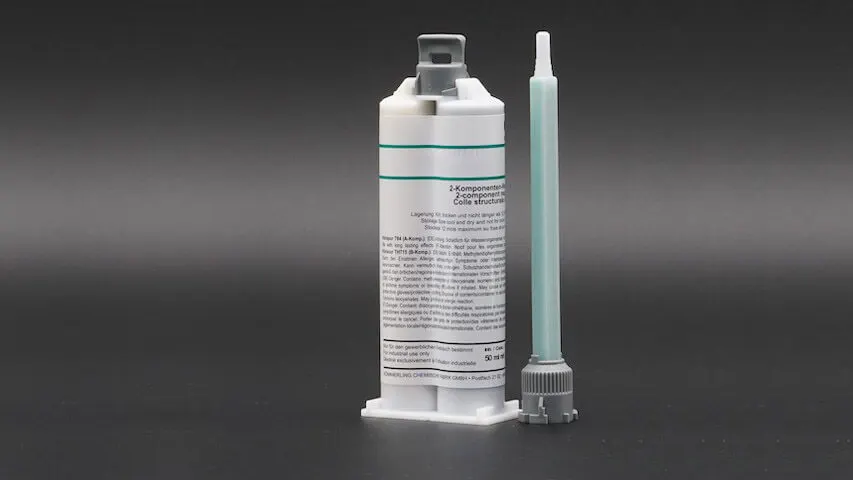
Epoxy adhesives are among the highest-strength structural adhesive families. In two-component (2K) systems, mixing resin and hardener starts a chemical reaction.
Strengths
- Very high shear and tensile strength
- Good adhesion to metal, composites, ceramics and wood
- Low shrinkage and gap filling
- Chemical and heat resistance
Weaknesses
- Can be rigid and brittle; elastic systems perform better under vibration and impact.
- Low tolerance to mix-ratio errors.
- Long cure times; usually not suited to fast lines.
Mix ratio and pot life
The resin/hardener ratio is given by volume or weight and must be followed exactly. Extra hardener does not add strength; it degrades it. Pot life is how long the mix stays workable; epoxy mixed in large volumes heats up and sets much faster (exothermic reaction).
| Parameter | Typical effect |
|---|---|
| Ambient +10 °C | Pot life roughly halves |
| Large mix volume | Heat build-up, early gelling |
| Wrong ratio | Soft or brittle joint |
Epoxy or an alternative?
Epoxy is ideal for rigid, load-bearing metal-to-metal joints. For materials with different expansion or for vibrating parts, 2K PU or MS/SE hybrid systems may be a better fit.
Need support with your application?Our technical team supports product selection and line trials.
Request a Quote