
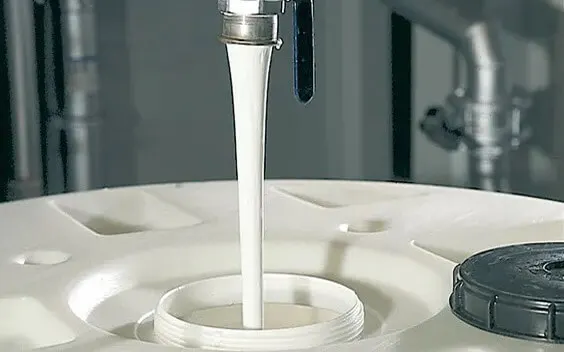
Viscosity is a liquid's resistance to flow. Honey has high viscosity, water low. In adhesives, viscosity determines how the product is applied, how far it penetrates the surface and how the glue line looks.
Unit and measurement
Viscosity is usually given in mPa·s (millipascal seconds, formerly centipoise) and measured with a Brookfield viscometer at a set temperature: at application temperature (e.g. 180 °C) for hot melts and at 20 °C for dispersions.
Rough comparison
| Material | Approx. viscosity (mPa·s) |
|---|---|
| Water | 1 |
| Olive oil | 80 |
| Low-viscosity dispersion | 500 – 2,000 |
| Honey | 2,000 – 10,000 |
| Edge banding hot melt (at application temperature) | 20,000 – 100,000 |
| Paste / MS polymer | Thixotropic, non-sag |
Viscosity and application method
- Spray: needs low viscosity.
- Roller: medium viscosity is ideal.
- Nozzle / bead: medium-high viscosity prevents stringing.
- Vertical surfaces and gap filling: thixotropic (non-sag) products.
The effect of temperature
Viscosity falls as temperature rises. A 10 °C increase noticeably thins a hot melt, while dispersions stored in a cold warehouse thicken and must be brought to room temperature before use.
Choosing the right viscosity
On porous wood, very low viscosity leads to absorption and a starved joint; on smooth plastics, high viscosity can mean poor wetting. Tell us your equipment and substrate and we will recommend the right range.